Saturday, 10 December 2016

A Life In The Theatre at the Eternity Playhouse

Great show! Here's my Artshub review http://performing.artshub.com.au/news-article/reviews/performing-arts/lynne-lancaster/a-life-in-the-theatre-252598  This early Mamet play, A Life in the Theatre, is a love letter to the theatre. It is at times very funny at other times extremely moving. Mamet uses The Theatre as a metaphor for life and it is a captivating portrayal of artists at work.
Stage veteran Robert (John Gaden) and young would-be major star John (Akos Armont) have previously worked on numerous plays together and have become more than familiar with each other, but their lives do not intersect outside the theatre – the generation gap is definitely an elephant in the room. John respects Robert but is considerably younger. John’s star is rising and he has developed a following and garnered critical praise – he has little time for Robert’s old school pedantic advice and superstitions.
There are some great comic scenes  in A Life in the Theatre – wardrobe malfunction, a prop malfunction in the operating room scene.There are lots of quick costume changes as they perform roles ranging from the sublime to the ridiculous – pastiches of old chestnuts such as shipwrecked mariners, earnest Russian gentry, a Shakespearean play, surgeons and trapped men in a trench in WW1 for example (and not forgetting the French barricade scene).
The set is designed to be with the ‘stage’ at the back so we see the cast playing the scenes of their touring shows with their backs to us. The ‘show’ is visible on the backstage monitors. The ‘auditorium ‘ is the Eternity’s heritage dome. At times, we the real audience become the mirror that Robert and John use.
Music ranges from cool jazz to reworkings of Bizet’s Carmen among other things. Lighting by Christopher Page is dynamic and atmospheric. Under Dallimore’s loving direction the play is excellently paced and fluid, although the many frantic tightly choreographed costume changes required on stage do at times break the mood a bit. The play shows fragmented views of the often rather crazy moments commonly experienced by those who work in the theatre – both awkward and golden – but always honest and relevant.
Theatre legend John Gaden as Robert was magnificent in a finely nuanced performance. He is charismatic as the vain older, garrulous actor with a glorious voice whose life is the theatre  is the smell of the greasepaint and the roar of the crowd. Gaden as Robert tries to pass on his knowledge and experience to John the younger actor as played by Akos Armont. He poignantly reveals the emotional self-doubt and uncertainty beneath the carapace of his autocratic professional demeanor. There are some very moving scenes especially towards the end when Robert reveals his tiredness and fragility and he has a powerful inspiring monologue to close the show. He transmits the delightful melancholy of an actor’s life which while producing a cornucopia of memories, quickly fades like a dream. What is reality?
The backstage drama swiftly moves in brief scenes that detail moments when tutor and pupil begin to switch roles. John begins to tune out Robert’s advice but Robert retains his elegant dignity. We are always aware that John will eventually take over Robert’s role as established veteran of the theatre in the never ending cycle of life and art. A wonderful show for anyone who loves theatre. 
Rating: 4 stars out of 5

A LIFE IN THE THEATRE

BY DAVID MAMET
Cast
John Akos Armont
Robert John Gaden
Director Helen Dallimore
Production Design Hugh O’Connor
Soud Design Jed Silver
Lighting Design Christopher Page

DARLINGHURST THEATRE COMPANY AT ETERNITY PLAYHOUSE NOVEMBER 2016
Running time 90 minutes no interval
A Life In Theatre runs at Eternity Playhouse 4 November- 4 December 2016
 

Purgatory at Mosman Art Gallery

A most exciting performance .Here's my Artshub review http://performing.artshub.com.au/news-article/reviews/performing-arts/lynne-lancaster/purgatory-a-chamber-opera-252571  The Orchestra dominated the Hall and for each piece there was a photo – often of Opera Australia productions – with the title of the appropriate opera. Musical Director and conductor Mark Brown welcomed us and introduced some of the pieces (and later, others were introduced by tenor Benjamin Oxley). Under Brown’s direction – his conducting is precise, rather finicky and restrained – the Orchestra was in inspired and in excellent form. For each of the works there was a photo or two projected on the screen stage left.
Purgatory – A Chamber Opera opened explosively with the overture Glinka’s Russlan and Ludmilla. It was a stirring performance and executed at a brisk rather breathless pace.
The bulk of the first half was the Australian premiere of Philip Rugel’s short chamber opera Purgatory. It was also the world premiere of the work in this particular orchestral setting. The two soloists were Judith Rough and Benjamin Oxley. Purgatory is based on Yeat’s play but features an Old Woman (Rough) rather than an Old Man, and her son (Oxley). We were transported to a country road where visions of an old house and a symbolic dead tree create harsh memories for the Old Woman. Are they already ghosts? Or it is her memories? A Poe-like tale enfolds of guilt, murder and revenge.
Oxley as the boy was menacing, caressing his dangerous knife. As the Old Woman, Rough was splendid, torn and tormented in black.There was a stormy, chilling opening and most effective use of red lighting to represent the burning house, and a most atmospheric photo of a dead tree.
Rugel’s score at times perhaps reminded me of some of Britten’s work. There is unexpected sudden violence and a wonderful evocation of thundering horses. In this hypnotic work the performances are stark and powerful and can give you goosebumps with a shattering, very tense ending.
In complete contrast was the Rossini overture to The Barber of Seville darting, sparkling joyous and much fun, which took us into interval.
The second half opened with a fiery relentless version of the famous Ride of the Valkyries from Wagner’s Ring Cycle in a shimmering, flowing performance. You could see in your mind’s eye the women on their flying galloping horses in the stirring, crashing music.
Next was the passionate, tempestuous Leibestod also by Wagner from his Tristan and Isolde; swirling and cascading, saturating the audience in a wall of sound. In some ways being a wind orchestra this actually had a rather jazz feel but was an almost overwhelming sea of passion. ​Then came the love scene from Puccini’s La Boheme. The singers were tremendous and we were dazzled by their lyricism and magnetic passion.
Oxley then introduced his colleague, baritone Joshua Rogers, who sang a darker, deeper version of Nessun Dorma (from Turandot). Rogers has a tremendous dark chocolate velvety voice but was perhaps a bit overwhelmed by the Orchestra’s volume. We then heard the captivating Spanish rhythms of Lara’s Granada, also sung by Rogers.That bought the concert to an official close but the audience demanded an encore and we were treated to a sparkling ,delightful version of the Brindisi (drinking song) from Verdi’s La Traviata led by the Oxleys.
Rating: 4 stars out of 5

Purgatory – A Chamber Opera 

The Australian Wind Symphony in Opera
Sydney Wind Symphony musical director Mark Brown
Soloists
Cheryl Oxley, Judith Rough, Benjamin Oxley , Joshua Rogers
Glinka – Russlan and Ludmilla overture
Rugel – Purgatory A Chamber Opera
Rossini The Barber of Seville Overture
Wager – The Ride of the V alkyries
Wagner - Liebstod ( from Tristan and Isolde)
Puccini – duet from La Boheme
Puccini – Nessun Dorma ( from Turandot )
Lara – Granada
Encore- Brindisi from La Traviata ( Verdi )

Purgatory was for one night only at the Mosman Art Gallery 6 November 2016 ​

Dads at Parramatta

Interesting . Here's my Dance Informa review http://dancemagazine.com.au/2016/11/celebrating-fathers-in-dance-makers-collectives-dads/ Riverside Parramatta, Sydney.
November 4, 2016. 
DADS is part of the wonderful FORM Dance Projects season at Riverside Parramatta and was produced by the Dance Makers Collective.
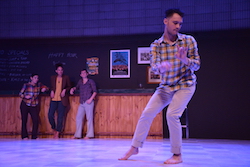
Dance Makers Collective's 'DADS'. Photo by Dominic O'Donnell.
Dance Makers Collective’s ‘DADS’. Photo by Dominic O’Donnell.
It was at times biting, witty and very funny; while in other sections, it was quite sombre and reflective. There were quite a few choreographic “inside jokes” for those who are aware of the independent/contemporary dance world — both in the voiceovers and choreographic allusions. The performers are linked to their fathers through the use of voiceovers of recorded interviews.
This work is about fathers, their influence on our lives and in this work, and also about dads dancing (or their fear thereof). The contemporary dance sections are developed from voiceovers of the dads’ memories – the difficulty of learning to waltz, awkward teenage parties, discovering their feet can be graceful or stumbling –  which occasionally have obvious links but often not. DADS was most enjoyable but had a perhaps slightly unfinished feel.
Through interviews with their dads and sessions in the rehearsal studio, Dance Makers Collective reveals a hidden world of dance practices including carport parties, door knobs as dance partners, sherbets for Dutch courage and the use of dance as a pathway for recovery.
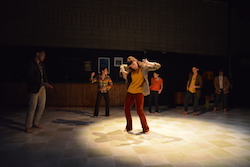
Dance Makers Collective's 'DADS'. Photo by Dominic O'Donnell.
Dance Makers Collective’s ‘DADS’. Photo by Dominic O’Donnell.
There is a terrific backward slithery opening solo holding a glass of beer, which then turns to a strong section using the exuberant, passionate voices of the Dustyesky Russian Men’s Choir from Mullumbimby as the nine dancers (male and female) move as a cohesive ensemble with fabulous timing and phrasing. Short solos occur — individuals scintillating for a brief moment in the spotlight before returning to the synchronised, tightly controlled gesturing full of tiny details and frenetic pacing of the group. At one point, a solo was like a rippling, darting fish; a different solo was far more angular with the use of elbows.     
Unfortunately, the words of the fathers’ voices are often hard to understand, as they seem to be amplified from what appear to be recorded phone and intimate home conversations.
Technically, the performances were amazing. Small, repeated phrases of  movement were used, concentrating on tiny details (such as the miming of smoking), as was a very acrobatic balancing act on a sofa (perhaps an allusion to Circa?), Ballet technique, contemporary, breakdancing and tango, as well as nightclub style dance, are included.     
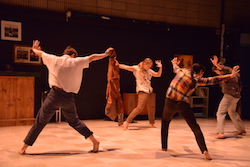
Dance Makers Collective's 'DADS'. Photo by Dominic O'Donnell.
Dance Makers Collective’s ‘DADS’. Photo by Dominic O’Donnell.
Popular music is used — golden oldies from the performers’ dads’ dancing days, such as “Only You”, and songs from Dusty Springfield, the Beach Boys and more. There are runs, rolling floorwork, a nasty choreographed fight. The tango sequence previously mentioned, with sizzling, flicking legs, becomes an extremely intimate sequence reflecting on the friendship of various dads and also father/son relationships. Dancing home alone, “Good Vibrations” turns into a silent primal scream.
DADS is quite revealing in parts, warm, thoughtful and funny. The audience loved the celebratory finale with some of the fathers joining their progeny on stage in a chorus line all gyrating to “I Will Be Alright”. In fact, a couple of the dads were the most impressive dancers!
By Lynne Lancaster of Dance Informa.
Photo (top): Dance Makers Collective’s ‘DADS’. Photo by Dominic O’Donnell.

Sydney Dance New Breed 2016 at Carriageworks

An interesting mix Here's what I thought for Dance Informa  http://dancemagazine.com.au/2014/11/sydney-dance-company-new-breed/Carriageworks, Sydney
November 4, 2014
By Lynne Lancaster of Dance Informa.
Five short new works under the umbrella title New Breedmarked the first of a new partnership between Carriageworks and Sydney Dance Company, supporting and encouraging the development of choreographic talent. Selected by Sydney Dance Company Artistic Director Rafael Bonachela, this short premiere season gave the choreographers an opportunity to create a work with the fabulous members of the company. For these performances, there was no real set, just the bare walls of Carriageworks, heavy lighting rigs and a white tarquet floor. However, Matthew Marshalls’ fabulous atmospheric lighting enhanced the glorious performances.
The opening work White Elephant by Lee Serle, inspired by the works of Australian artist Stephen Bush, was most unusual and confronting. The idea was that the dancers inhabit the surreal landscape and are the landscape. The cast at the beginning was playing with sculptural piles of origami. Sometimes there was an emphasis on correct, almost rigid, balletic epaulement. There were repeated phrases of movement, and wonderful unified ensemble work that was contrasted with frenzied individual movement. Bernard Knauer had a stunning short solo and was on a very high relevĂ©, almost en pointe. Abar the Elephant is one of the characters and there is a trio for him prone on the floor with two of the women.
Charmene Yap’s Do We was a magnificent pas de deux for Holly Doyle and Bernard Knauer in elegantly casual beige costumes. There was a relentless, driving rhythm as provided by Gypsy Mandolin. The dancing was lean, powerful and athletic with unusual partnering, a wonderful line and terrific jumps. It had a gripping, intense atmosphere and there was a very effective use of echoing/mirroring.
Sydney Dance Company's 'New Breed'
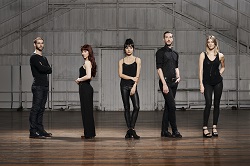
Sydney Dance Company’s first ‘New Breed’ choreographers. Photo courtesy of Sydney Dance Company.
The third work was Cass Mortimer Eipper’s Dogs and Baristas, inspired by the idea of us all needing portion sized friendship. It opened with a white corridor of light and included speech and guttural sounds, claps and slaps. There were some repeated phrases of movement – at times the dancers appeared to be sculptural machines (coffee machines, given the work’s title?) Glorious softly padded jumps were contrasted with angular movements. Special mention must be made of the sensational solo for David Mack.
Juliette Barton’s Scrutineer was an intense, crackling solo that dazzled. It was about the art of looking – and who is observing whom. Barton was in a short, revealing brown shift and beige socks, her sensational dancing is full of creamy movement, a laser sharp line combined with the use of a very flexible back. Undulating arms and a deep Graham-style plie are used as well. The final section of this work was a twitchy, disturbing and nightmarish segment that used a long black bench as support. Rolling floor work is included. By the way, flickering, pulsating strobe lighting was used, which some viewers might find quite disturbing.
Based on the idea of exploring space, the final work, Gabrielle Nankivell’s Wildebeest, was extremely strong and powerful. The thinking behind the work was that underneath it all we are animals. The dancers were mysterious alien beings, or were they meant to be Frankenstein’s creatures? On a stormy night, Luke Smile’s soundscape throbbed and crashed. Laser-sharp leg lines were contrasted with fluid, rolling floor work. Formal, stylised choreography was contrasted with runs and some most unusual lifts. Were we meant to pick up allusions to Matthew Bourne’s Infernal Gallop? Janessa Dufty’s long solo concluding the work was amazing.
Overall, this was a fascinating, most exciting programme!
Photo (top): Do We being performed by Sydney Dance Company in New Breed. Photo by Peter Greig.

The Royal Ballet in Anastasia

This was amazing , Natalia Osipova magnificent .Here's Sydney Arts Guide review http://www.sydneyartsguide.com.au/the-royal-ballet-presents-anastasia-the-royal-opera-house-london/ A must see for balletomanes, this is completely Natalia Ospiova’sshow as Anastasia and she is more than sensational.
The Royal Ballet has just completed the live performances of this production which took place at between the 26th October and the 12th November. We are privileged to see this amazing production via the filming of the performance which took place on the 2nd November which is being presented as part of the current Palace Opera and Ballet season.
The ballet’s subject is the mysterious woman, known as Anna Anderson, who was incarcerated in a mental hospital in Berlin from 1920 and claimed to be Anastasia, daughter of Tsar Nicholas II, who somehow escaped from the cellar where the imperial family had been murdered by the Bolsheviks. Choreographer Kenneth MacMillan explores the whole notion – Was she or wasn’t she?!  
The last act was created first in Berlin during the 1960’s the other two acts added in 1971 upon MacmIllan’s return to London and it had some tweaking and reworkings in 1996.
The score uses Tchaikovsky for the first two acts and blends sharp electronic music and a Martinu symphony for Act 3.
There is a sense particularly in the first two acts of a lost world of almost decadent luxury. Some of the women’s costumes with their lace and pearls are simply ravishing.
The first act of the full-length version takes place on the imperial yacht and the second in the imperial palace.
For Act 1 there is a tilted steamer funnel with the Imperial eagle, for Act 2 chandeliers at odd angles that look like exploding fireworks.
Act 3 is set in a bleak psychiatric ward empty but for a bed. Original grainy black and white footage of the Romanovs is included.
MacMillan’s fiendishly difficult, brilliant choreography is dazzlingly danced blending contemporary dance, folk dance, formal ballroom and ‘traditional’ ballet. There are some amazing challenging lifts in the pas de deux. The choreography features a mix of expressionism, lyricism and classicism.
There are fragments of folk dance in both the first two acts, the nurses in Act 3 stamp out a Russian dance, while in Act 3 the well-dressed visitors are rather threatening and overly inquisitive. Do they recognize ‘Anastasia’?!
Superstar Osipova as Anastasia was amazing, giving a sublime performance. In Act 1 she is luminous as the young tomboyish Anastasia, and has a delicious entrance on roller skates.
In Act 2, her coming out ball, she is radiant and refined but still with hints of her younger self. In Act 3 ,with her short gamin haircut and wild, haunted eyes, she is incredible in a  gut wrenching performance as ‘mad’ Anastasia/Anna Anderson with fragmented memories of her past life.
She shapes each phrase of Macmillan’s extremely demanding – at times almost impossible – choreography with rigour and great subtlety allowing us glimpses of a tortured soul.  
In Act 3, while watching archival footage with deadened eyes, Anastasia suddenly jumps up from her chair, impulsively stretching out to what she believes is her past self.
As her parents Nicholas 11 and Alexandra, Christopher Saundersand Christina Arestis were regal yet loving. Her three sisters and their suitors are enchantingly portrayed.
In Act 2 as part of Anastasia’s birthday celebrations there is the set piece Kschessinskaya pas de deux for the ex mistress of the Tsar and her partner which is in some ways like the Black Swan pas de deux from Swan Lake. Marianela Nunez was dazzling in her short black and gold tutu as was her dance partner Federico Bonelli.
Thiego Soares as Rasputin was tall, ominous and menacing. The choreography alludes to the rumours of how he manipulated the Romanovs yet was also influential in healing the Tsarevtich Alexei’s life. at times.
Edward Watson as The Husband in Act 3 was splendid with some very tricky lifts in the pas de deux. The question is, did Anna remember him?!
This was a magnificent, challenging and harrowing work presented by a master of choreographic and emotional nuance.
Running time – allow 3 hours 10 minutes which covers two intervals. During the  intervals there are behind the scenes of the production snippets as well as interviews.
ANASTASIA, part of the Palace Opera and Ballet season, is screening at selected Palace cinemas until 7th December.  

Theodora by Handel as performed by Pinchgut

Musically and vocally superb, here's my Artshubh review http://performing.artshub.com.au/news-article/reviews/performing-arts/lynne-lancaster/handels-theodora-252780

LYNNE LANCASTER

Vocally and musically splendid.
Handel's Theodora
  Valda Wilson as Theodora. Photograph by Robert Catto.
Handel loved his Theodora, rating it far above his other Oratorios. However, it was not popular in his day, but since the very late Twentieth Century with the landmark production at Glynbourne in 1996,  Theodora has gradually found its rightful place among his Baroque masterpieces.
Yet again, here under the magnificent direction of Lindy Hume, Pinchgut thrills and delights us with this glorious production. Musically and vocally it was ravishing, the Orchestra of the Antipodes under the bouncy, enthusiastic yet extremely precise direction of Erin Helyard were lush, dynamic and lyrical – soaring yet well controlled – look out for the contra bassoon especially required for this opera. Tempos were elastic and flexible, the strings rich velvety and detailed. A delicate haunting flute is featured in Theodora’s prison scene, contrasted with braying horns for the Romans especially in the opening feast after interval and scurrying violins in arias such as 'Sweet Rose and Lily'.
The plot is simple and set in ancient times but still resonates today. Christians are being persecuted in China and the Middle East but it could also be representative of any sect that disagrees with the ruling powers and protests: ‘us’ vs ‘them’. Valens, autocratic Roman ruler of fourth-century Antioch, demands everyone sacrifice to Jupiter for the Emperor’s birthday celebrations. When the Christians decline, Theodora, a prominent member and a virtuous noblewoman, is arrested and threatened with being forced into ritual prostitution – for her, a fate worse than death. Didymus, a Roman soldier and secret Christian convert, chastely in love with Theodora, exchanges clothes and places with her, so she can escape, but when he is condemned in her place Theodora returns and ‘they blissfully enter immortality together’ in a double martyrdom.
Under Hume’s direction the staging was rather sparse and simple, with minimal sets and effects. The raised platform stage with steps took up most of the space.There was a tilted screen used for the surtitles and some of Matthew Marshalls’ very atmospheric, glowing lighting and special effects such as clouds (or angels wings?) for one of Theodora’s solos. There was also a heavy tilted square lighting rig up high, with grey plastic clouds (brewing storm clouds?) The Romans were identified by a gloved hand and mottled painting on the sleeve of one arm. The Christians were plain clothed – so the chorus could easily change from ‘saints‘ to ‘sinners‘ by changing or removing the coats. 
International star Aussie Valda Wilson dazzles and captivates as Theodora. Noble,virtuous and strong she is also vulnerable underneath, yet her faith will conquer all. Her first solo ‘Though Hard‘ is inspirational and her troubled solo when in prison ‘O Thou Bright Sun’ was a soaring prayer. She sings with a radiant freshness.The duets between her and Didymus when they are falling in love were lush and exquisite. Our hero, counter tenor Didymus was magnificently sung by international star Christopher Lowrey (last seen in Sydney in Pinchgut’s Bajazet). from his first rousing solo 'The Raptured Soul' he had us spellbound with his warm voice. His flourishes and stylish ornamentation were galvanised at times with great agility without renouncing his lyrical smoothness. Tall, dark and handsome Septimius, Didymus’ friend, was splendidly sung by Ed Lyon, dashing in his military uniform. He does his ‘duty’ as commanded by Valens but with great reluctance (‘Descend Kind Pity‘ was magnificently sung). He has a versatile range with delicious upper timbres for his bright tenor and an agile, sinewy tone. He is torn between his duty and compassion and his friendship with Didymus. He secretly helps Didymus exchange places with Theodora and is left alone and devastated crouched and grieving. Irene, the female leader of the Christians in Antioch was beautifully sung by Caitlin Hulcup. She was calm and strong, her solos 'The Clouds Began to Veil' and 'Defend Her and Lord To Thee Each Night and Day' were sensational. She sang with limpid mellifluousness and was firm and inspired. Valens the tyrannical Roman governor was portrayed by Andrew Collis as menacing and perhaps slightly mad, turning ‘Racks, Gibbets, Swords‘ into an astonishing, furious aria.
A minimalist rather restrained staging of the sweeping musical drama. Theodora  is musically and vocally tremendous and the 18th century sound is lush and detailed. Go on – treat yourself.
Rating: 4 stars out of 5

Handel's Theodora

BY GEORGE FREDERICK HANDEL

Valda Wilson                    
Caitlin Hulcup                  
Christopher Lowrey    
Ed Lyon                      
Andrew Collis              
Cantillation                    
Orchestra of the Antipodes
Erin Helyard, conductor
Lindy Hume, director
Dan Potra, designer
Matthew Marshall, lighting designer
Sally Blackwood, assistant director
Keiren Brandt-Sawdy, assistant conductor

Pinchut Opera
City Recital Hall
30 November - 6 December 2016​

Mack and Mabel at the Hayes

This was sensational , absolutely brilliant. Here's my Artshub review
http://performing.artshub.com.au/news-article/reviews/performing-arts/lynne-lancaster/mack-and-mabel-252725 Mack and Mabel is dynamite; sheer theatrical magic. Directed by Trevor Ashley, this is a magnificent production of the 1974 Broadway musical that was regarded as a flop at the time yet has developed a cult following and is best known perhaps for Mack’s song 'I Won’t Send Roses'.
With book by Michael Stewart and music and lyrics by Jerry Herman, the plot involves the stormy romantic relationship between silent film Hollywood director Mack Sennett and Mabel Normand (in the musical she is a waitress from a deli ‘discovered ‘by Sennett). Most of the conflict is between the two main characters – Stewart became one of Sennett's biggest stars, his major muse and inspiration. Told in a series of freeze frames and flashbacks, Sennett as narrator describes the glory days of the Keystone Studios from 1911, when he discovered Normand and cast her in dozens of his early 'two-reelers' (as distinct from longer feature films) through to his creation of Sennett's Bathing Beauties and the Keystone Cops to Mabel's death in 1930. 
Mack and Mabel is full of pizzazz and stylish, zippy choreography by Cameron Mitchell. Bursting with exuberance, there is wonderful comic timing with the slapstick numbers – the extremely detailed tightly choreographed bits in 'Look What Happened to Mabel', and the pie-in -the face scene for 'I Wanna Make The World Laugh' plus the Keystone Cops segment in Act 2 were dynamite. The Bathing Beauties scene rivals that of Busby Berkley and Ethel Merman and yet there was more with giant full cast production numbers.
Costumes as designed by Angela White are stunning. Lauren Peters’ movie studio-inspired set design creates the atmosphere immediately and allows for the many fluid, flexible scene changes. The band, hidden at the back, vibrantly directed by Bev Kennedy, were splendid and played exuberantly.
As Mack Selleck, tall and charismatic Scott Irwin is fabulous. Seemingly gruff and cold – a tyrant obsessed with his work – dominating, stubborn and often abusive where Mabel is concerned but he captures Mabel and our hearts with 'I Won’t Send Roses'. Despite sizzling chemistry between the pair and a mutual need, Mack eventually drives Mabel to leave, in a search for artistic integrity and self development, and she ends in a downward spiral without much support. Irwin’s warm, luscious baritone leads the audience through the show in reflective monologue and song, Irwin as Mack Senneck emanating a deep sense of love and regret.
As Mabel Normand, Angelique Cassimatis is luminous, setting the stage alight. She dazzles and delights, stealing our hearts from the opening number 'Look What Happened to Mabel' . She is simply enthralling in all her numbers revealing her enormous emotional range and acting and vocal versatility (not to mention her unforgettable dancing) 'Wherever He Ain’t' is furious and defiant, 'Time Heals Everything' sadly aching for example and her disintegration towards the end is sadly charted.
Shaun Rennie charismatically plays the suave, sophisticated villain of the piece, William Desmond Taylor, a rival director of serious films, luring Mabel away from Mack and gets her hooked on drugs and booze. Her involvement in his death trips Mabel onto dangerous side of scandal and notoriety. As Lottie Ames Deone Zanotto is superb wowing us all through the show but especially when leading the Big Time number in Act 1 and 'Tap Your Troubles Away' number in a gold fringed outfit.
Frank Wyman, an actor/writer, and later a director, one of Mack’s team, was sensitively played by Adam Di Martino and Fatty Arbucle was enchantingly played by Stephen Valeri .
With great flair and a cavernous heart hidden under a seemingly gruff exterior this show will enchant. Run and book now if you haven’t already. 
Rating: 5 stars out of 5

MACK AND MABEL 


Book by Michael Stewart
Music by Jerry Herman
Based on an idea by Leonard Speigelglass
Director Trevor Ashley
Choreographer Cameron Mitchell
Musical Director Bev Kennedy
Set Designer Lauren Peters
Costume Designer Angela White
Lighting Designer Gavan Swift
Sound Designer Neil Mclean
Casting Director Lisa Campbell
Producer Wendy Richards
Production Manager Laura Daniels
Stage Manager Gints Karklins
Starring Scott Irwin and Angelique Cassimatis
with Deone Zanotto, Stephen Valeri, Kuki Tipoki,
Adam Di Martino, Shay Debney, Sally Hare, Caroline Kaspar,
Mikayla Williams, Jessica Voivenel, Zachary Webster and Shaun Rennie.

Mack and Mabel runs at the Hayes Theatre 18 November – 18 December 2016